Lord that I may See - SERMON

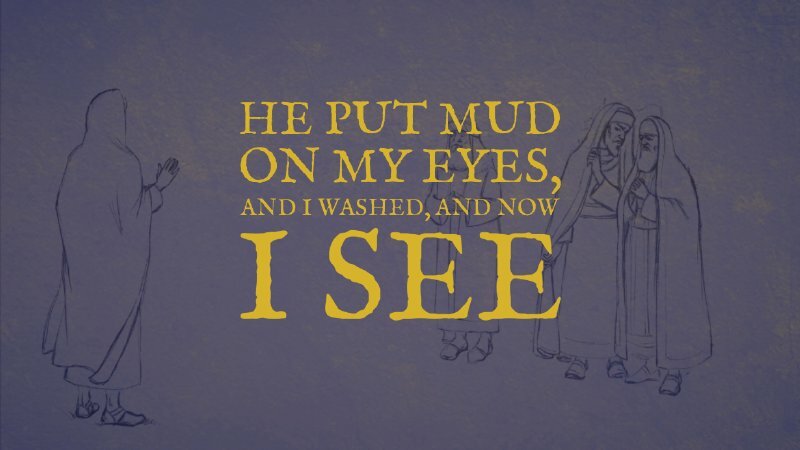
4th Sunday of Lent - Lord that I may see
There’s an old film from the late 1980s called “They Live”. In the movie, a man named Nada discovers a pair of special sunglasses. As he put them on, he suddenly saw the world as it truly is.
Beautiful advertisements hide secret commands like “Obey,” “Consume,” “Conform.” Also, through the glasses, those who appeared successful and powerful are revealed as something monstrous. They were alien creatures trying to dominate human kind feeding on their greed, vanity, and blindness. Once he saw the truth, he could never go back.
We live in a culture not so different from the false city of “They Live”. Everywhere around us, invisible messages are whispered. “You are what you own.” “Buy to be happy.” “Success defines your worth.” Money promises security. Success promises happiness. But behind that glittering surface lies a blindness that keeps us from seeing what really matters.
When those messages become the measure of our worth, we lose sight of the truth of our being that each one of us is precious, loved, and made in the image of God. In that sense, the change of vision fits well with Christian journey of conversion. Faith begins with sight, a new way of seeing that shatters illusion and reveals truth. As Christians, we are called to put on new lenses, to see life with the eyes shaped by grace, not by greed or fear.
And in today’s Gospel, Jesus does exactly that for the man born blind. With a touch of mud and water, He opens the man’s eyes. But this was beyond physical healing, a spiritual awakening. The man’s journey moves from darkness to light, from confusion to confession, from an outcast from society to a follower of the Lord. Meanwhile, those who claimed to see remain trapped in their own blindness. Lent asks us to take off the world’s glasses and look through the eyes of Christ. It is a season that slows us down long enough to notice just how dulled, distracted, and distorted our vision has become. How money, social image, or status have quietly become idols. We begin to sense how easily our hearts bow to the false gods of comfort and control.
Yet, for those like us here, who resist false promises and remain hungry and thirst for God’s truth, goodness and beauty, our sacred yearning becomes the very path that leads us to Jesus,
the one who reaches out to touch our blindness and restores our sight. We are here to be touched, awakened, renewed. Then what happens when we encounter Jesus? The way Jesus touched the blind man leaves us something to ponder. As we look closer, Jesus spits on the ground and makes mud with the saliva and spread it on the man’s eyes. At first glance, this feels awkward. Some may think it could have been a lot more impactful if he used some other ways, like a magic wand.
But in this scene, I was somehow reminded of the ash we received at the beginning of Lent.
We are from ground, and we return to ground. Without grace of God, we are nothing but handful of dirt. Yet in the grace of God, we are called to children of God. Jesus, the Word who created all things at the beginning continues to create us anew. Then Jesus asked him to wash with water in the pool of Siloam, which means sent. Here, water reminds us of our baptism, a sacred passage of renewal and rebirth. We need to remember blindness like any other physical illnesses were considered as punishment of God, which was judged and shamed by others. However, Jesus was not hesitant to engage with this man. Until this blind man encountered Jesus, no one, including himself, found any dignity as a legit member of the society. Yet, Jesus rekindles humility and trust before God and guided him to be renewed in grace of God. As he is fully restored by Jesus, the blind man who was isolated from the society is now joined Jesus on a new journey.
When Jesus touches our blindness, He also awakens us. As we come to know Jesus, not as a third person but in a direct, intimate, personal way, Suddenly, life looks different. We ourselves are more than what we possess. The poor are no longer invisible. A neighbor’s pain calls to us. Gratitude replaces entitlement. Hope rises out of despair in faith in God.
In this sense, Lent is about precisely this re‑seeing of the world. Letting God’s light reveal reality and reshape our hearts. That’s why the Church calls these middle Lenten Sundays the Scrutinies”, moments for us to let Christ scrutinize our hearts, not to condemn, but to heal and illuminate.
But sight brings struggle. The man in the Gospel pays a price for seeing. He is cast out even after he is healed because his vision threatens those who live comfortably in the dark. In the same way, when the light of Christ exposes truth in our culture, our priorities, even in our own hearts, there is tension. Living in the light of Christ isn’t always comfortable. It exposes our own shadows too; our pride, our fears, our attachments. Yet this honest seeing is the beginning of freedom.
We may feel like we are trapped in between not making a full commitment, yet, this struggle isn’t failure; it’s the path of conversion. It’s in wrestling with light and shadow that our faith deepens and our freedom grows.
And we don’t walk that path alone. The same light that reveals our sin also shows us our belonging to Christ and to one another. Lent is the journey of the whole Church seeing together, repenting together, loving together, until Easter dawn breaks fully. In a few moments, we will come to the altar. And here, sight is once more transformed. We look upon simple things, bread and wine. The world might call them ordinary. But faith lets us see what’s hidden to the naked eye.
This is Christ who gives His whole self, who receives our whole selves pouring out mercy and love for the world. As we join the Eucharist, we are like the man born blind. We are touched by Jesus, and our hearts illumined again. The illusion of isolation gives way to communion, and the false light of the world yields to the true Light of Christ.
So as we receive Communion this Sunday, let’s make the prayer of the healed man our own.
“Lord, that I may see.” See You in this bread and cup. See You in every person around this table. See You in the world You’ve called us to love and serve. And, like him, may we find our sight so renewed that we too can fall at Your feet and say, with all our hearts, “Lord, I believe.”
Father James
-
Location
Office Hours
Contact

