Epiphany Wise Women - SERMON

How We Engage with What We See
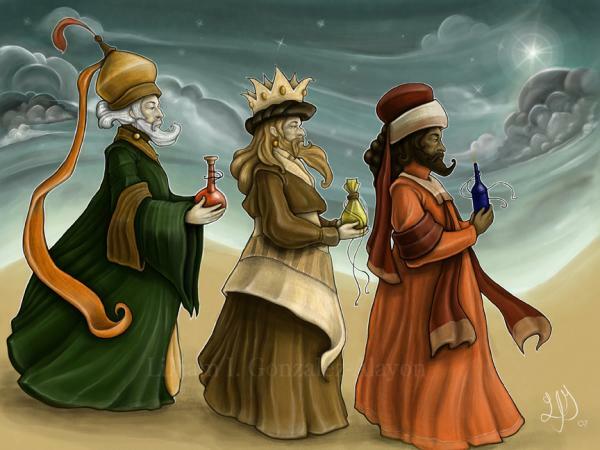
As we heard from the Gospel, three wise men visited the newborn Jesus. They were wise enough to read the signs written in the night sky, which revealed them the birth of a new king. Trusting the light they had seen, they set out a long and uncertain journey till they found a place where it happened.
On their visit, they brought gold as a symbol of his kingship, frankincense for his divine priesthood,
and myrrh, the embalming oil, as a reminder of his humanity and destined sacrificial death.
As I pondered that scene, another story came to mind; one that reimagines the moment with a gentle question. What if there had been three wise women instead of three wise men?
If they have known and come to visit the newborn Jesus, perhaps they arrived early to help deliver the baby, tidy the stable, and they might have brought casserole for Mary and Joseph, diapers, and formular for baby Jesus, and warm blankets for the holy family. It’s a refreshing and endearing thought. After all, what good are gold, myrrh and frankincense in the middle of nowhere when Mary has just given a birth to Jesus. A practical, life-sustaining gifts seem more reasonable.
Yet as I lingered with this story more, many challenging questions surfaced. Why weren’t there wise women visiting Jesus in the original story? Even if such a scene had unfolded, why do we imagine only women bring more practical things?
This reminded me of a conversation at our church’s Christmas fair review meeting. Six female members and I were sitting on the table, and someone said that it would be nice to have some men for the team. I joked “Well, I am here”, but I understood her point. Then I added that it does not have to be gender biased. It was quite common for women to bring stronger gifts of hospitality and care than men. Yet, I have to say it comes more from nurture than nature.
For example, I love cooking and making craft, setting tables for others and cleaning the aftermath.
And for sure, many women today excel at tasks long considered men’s work as well. Living in post-modern, deconstructed world, we now move beyond old fashioned way of thinking. We do not need to consider caregiving and homemaking as women’s work. At the same time, we do not need to assume that men are out of touch with reality and ignorant of what was needed in real life situations.
So, I imagine, in a contemporary retelling of the Magi’s visit, wise men and women together could figure out where God’s message was sown, and found out where it happened, and brought gifts fitting the newborn Jesus of today. Then the question comes which gift is a truly necessary one.
Are those three wise men to be blamed for not bringing what a mother and a new born baby would need? Between gold, myrrh, frankincense and diaper, casserole, formula, which one do you think would be proper gifts to Mary, Joseph, and Jesus? What would you bring? For sure, they must have been cold and hungry, and it is undeniable that their immediate needs to be met first. But would that be all they need?
You may recall a story of the beggar and the rose. One day, a beggar was begging for money as usual, and someone who was passing by gave him a rose. No one gave him a rose before, and usually people just pitied on him at best. And now someone saw him as a person who could also enjoy the beauty of a rose. It made him think of his life in a different way and motivate himself to change. It is just a story, but it has a point.
Yes, people on the street needs food and money to get by. But at the same time, they are hungry for being treated as another human person with dignity. They are not just hungry for food, but hungry for dressing up nice and neat, hungry for having a normal conversation with friends, hungry for being treated as a decent human person. When everyone else saw only hunger for food in this beggar, the person who gave him a rose saw a different hunger in him.
As we go back to the scene of Magi, when they came to see the newborn Jesus, what they brought represented what they saw in Jesus. They saw the King who would govern the world with love and mercy. They saw the priest who would unite heaven and earth. They saw a suffering servant whose death that would bring a new life to all. And they honored him with gifts that matched what they saw.
In that regard, I would like to extend my imagination that there were more people with wisdom, who came to visit Jesus, while bringing gifts that resonated with what they saw in Jesus. Some brought gifts that revered what he would become to the world. Others offered nourishment and comfort for what he would need in the world. As the light of the world entered the world, it not only gave a new hope and vision to people who were seeking for a light but also made them engage with that unfolding mystery by offering what they thought would be fitting and needed. As Jesus revealed himself in the world, he shed a full spectrum of light.
Jesus is a king, a sacred priest, a bearer of God’s divine mercy.
Jesus is hungry, thirsty, and lonely.
Jesus is son of God and Jesus is son of man.
Jesus is eager to love us and waiting for our love.
Jesus is everything about God, and everything about human person.
When we stand before Jesus Christ there are so many facets that touches everyone’s heart in unique ways. And part of us finally come to life as we connect with God through our participation. Certainly, Jesus was born 2000 years ago, and he revealed God’s mystery of love fully once for all. Yet, the incarnation continues to unfold till the end comes, and even now somewhere, Jesus is waiting to be born anew, and waiting to be noticed, waiting to be revered and attended, waiting for us to make a room for a new hope to be born. We learn how to grow the kingdom of God among us from these wise men and women.
First, we must become seekers. Moving beyond our self-centeredness, beyond our ego, and reaching out the world larger than us, searching for purpose of our being within a world bigger than us.
Then we must become seers. God dwells among us but remember many did not see messiah in Jesus and did not even recognize him after he was risen from the dead. Our Lord who promised to be with us can be anywhere. In the faces of our neighbors, in the beauty of nature, in things to be revered, to be restored, to be touched, to be connected.
Finally, we must become offerors. As we see Jesus, we offer what is due. In this way, we participate in God’s unfolding mystery. In offering, we receive. It can be food for Jesus who is suffering with the hungry, it can be praise and thanksgiving to Jesus who is the source of all good and beauty.
As we seek, see, and offer to the Lord who continues to reveal himself/herself in every generation, we are invited to live into a fuller, brighter expression of love. May our lives become radiant with his light, so that through us, others may come to see the glory of God revealed in love.
Fr. James
-
Location
Office Hours
Contact

