Empty Tomb - God's liminal space for our loss - Easter Sunday Homily

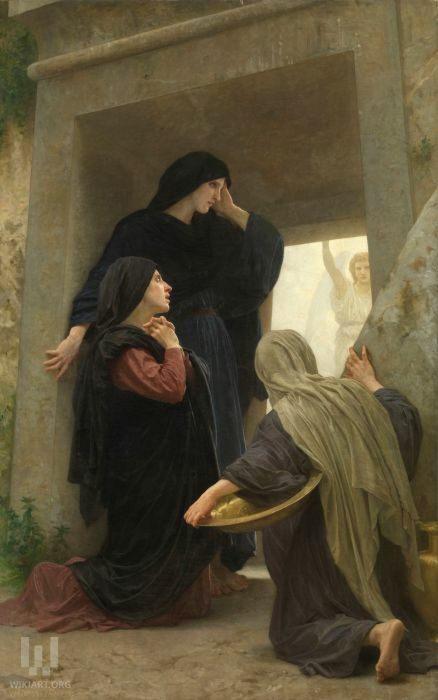
Sometimes art gives us new insights through the imagination of the artist. When I first saw the painting “Holy Women at the Tomb” by William Bouguereau, what caught my eye was the striking contrast between the inside and outside of the empty tomb.
As you look at the painting above, you will notice the tension in the scene. The women came with spices to anoint the body of Jesus, while still grieving, and expecting only silence and sorrow. The stone is rolled away. The tomb is open. In spite of the light from an angel illuminating inside the tomb, their faces, posture and hands holding the stone wall, tells more of confusion, and even fear. They have lost the one who gave their lives joy and meaning, and they could not yet imagine anything beyond loss.
I find their experience so deeply human. They stand in a kind of “liminal space” where they have not fully entered into a new reality, but aware that something beyond their understanding has begun. In that sense, empty tomb is like a threshold between endings and beginnings, between grief and hope, between what we cling to and what God is inviting us to see anew.
The tomb may look empty, but it is still full, full of memory, full of grief, full of everything that once felt certain, but now belong to the past. And yet, it is also empty because nothing remains to confirm their loss. The emptiness itself becomes an invitation to look for what is given anew beyond their understanding. And it involves hesitation, anxiety as they were stepping into the unknown.
I have recently experienced my own kind of “empty tomb.” Recently, I was away in Korea visiting my parents. They are doing well, thanks be to God, but I have already noticed the changes as I chatted on the phone. My father, especially, seemed to have aged quickly. Even with hearing aids, he struggled to follow conversations. He got tired easily and took more naps. Someone said, time moves quietly, and sometimes we don’t notice its footsteps until we return home.
One thing I planned for this trip was bringing back some old photos to hang them on the wall at my place here. My mother and I sat together, pulling out photo albums long gathering dust. One by one, the pages stirred up memories; childhood birthdays, family vacations, weddings, simple days at home. My mother filled the gaps of each photo with her stories, remembering details I’d forgotten.
In those faded, discolored images, I also met my parents again; young, strong, and full of dreams. My mother looked bright and lively; my father looked serious, determined, ready to take on the world. I wondered what they were like back then.
And now in contrast, they both look older, more fragile, quieter. Actually, as I was planning the visit, that was exactly why I was not so much excited about the visit. I didn’t want to face the reality of change, the gradual fading of the familiar. Even though I had a difficult relationship with my father while I was growing up, I still rather wanted to see my father as he used to be, stubborn and rigid. But there we were, no longer arguing about much anymore, just sharing quiet moments, talking about ordinary things, aware of time slipping through.
I wasn’t ready to face that change, but they seemed to have already made peace with it. They seemed content, grateful for the lives they had lived, and they have.
Certainly they were aware that what they had built throughout their lives were not gone. Instead, all those moments of living and loving continued to flourish in my brother and me. Also what was coming with aging was not just uncertain reality for them. As they had strong faith in God, there was a calm assurance for a life after death whenever it would come.
Their lives may seem to have changed, but their past and their future were not absent, but so much present but in a different form. In that realization, I recognized something Easter-like.
They trusted that their stories would continue in others, and that their future rested in God’s hands. What looked like loss was, in truth, the beginning of something new.
In faith, nothing is ever truly lost, and in love, nothing is finally uncertain.
When I think of the women at the tomb again, I wonder if their experience was much the same. They came as they were bound in grief. Then the emptiness spoke “He is not here.” At first, those words must have pierced their hearts with confusion. But slowly, that emptiness filled with meaning and a new hope. God was doing something they could not yet name.
In a sense, I think Resurrection rarely begins with joy or clarity. It often begins in bewilderment as we enter into the threshold space. The women expected death, but encountered life. They came to mourn, but were sent to proclaim. Their first reaction was fear, but soon that fear turned into motion; they ran, they told, and gradually it led them to believe. It changed their perception of past and future. That is how resurrection faith takes place. We do not always understand it at once. The path is uncovered each step as we move forward.
My encounter with my parents reminded me that resurrection is not only a miraculous event two thousand years ago but a pattern woven into all of life. Every one dies a little each moment as time changes us, and we are forced to let go.
And yet, as we walk the path with God, God keeps transforming endings into beginnings. In fading memories, a deeper love emerges. In surrender, hope takes root.
The good news of Easter is that the same power that raised Jesus from the dead still moves among us. Sometimes it comes through aged hands of our parents that still bless us, or through forgiven hearts that dare to love again, through weary spirits that yet find new budding hope.
The tomb is empty because God’s promise is full. The message of the angel echoes through every generation: “He is not here, he is risen.” It is the same message that meets us in our own “empty tombs,” in moments when we thought it was all over, yet somehow new life begins again.
Jesus lived and died embodying perfect love. And through his life and resurrection, we are drawn into that same love. True love is not something we can possess or control. It is something that we are part of, guiding us and connecting us within the ever-lasting hymns of love, which has begun in God’s heart, carried through history, still sung in our own lives today until the melody gathers all of us into the fullness of God’s love.
So this morning, as we stand before the mystery of the empty tomb, let us remember that the story did not end there. The tomb was empty because God’s love had begun anew again and again. The Cross was not the conclusion, but it was the beginning of a new creation.
In faith, nothing is lost; in love, nothing is uncertain.
Where love abides, life always rises again.
Fr. James
-
Location
Office Hours
Contact

