Together with God, We Can - SERMON

On 23rd May, with a few members of our parish, I was at the mission conference in Vancouver. The keynote speaker this year was bishop Michael Curry who recently retired in 2024 as the primate of the Episcopal church in the State.
It was such a refreshing and inspiring time, his message was so charismatic, enthusiastic, and radically rooted in the love of God. One of the things that stayed with me was a quote he shared, attributed to St. Augustine, and frequently quoted by Archbishop Desmond Tutu. “Without us, God won’t. Without God we can’t. But together with God, we can.”
The original quote from St. Augustine is “God created us without us, but He will not save us without us.” What does it mean? We believe that there is nothing impossible to God. But God would not save us without us?
As we look into the salvation stories in the Bible, certainly God always works through people. He calls someone, and patiently waits for them to response, even when they hesitate or likely fail to do what God asks. At a quick glance, it seems like an exhausting process. Why can’t God just change everything brand new all at once?
Clearly, God does not want us to be a mere recipient, but He wants us to participate. As I reflect on this, I am reminded of different parenting styles. In Korean culture, there has been a growing concern about young adults who are not fully capable of managing their lives as an adult. Behind that phenomenon, there are parents who are either overprotective or mostly absent. Some parents never allow their children to initiate anything on their own. They lay out every plan for what to do and what not to do, based on what they believe is the best for them. As a result, the children are left only to follow instructions or rely on their parents to solve difficult problems for them.
On the other hand, some parents pay little attention to what their children do. While they are sent to do various extra things, they are not checked or accompanied. As they are left on their own, they do not learn how to listen to others’ advice or ask for help. They may inevitably repeat the same mistakes and get stuck in a bad habit or give up easily and lose their way. So where do we find the right balance?
Imagine a child trying something new, assembling something, cooking, or learning to ride a bike. In the best scenario, parent and child work together. The parents allow the child to try, offering some guidance or encouragement at the beginning. As the child fails, the parents comfort them with their failure, reflect together what went wrong, and encourage them to try over again. In this process, there is a sense of learning, growing, and trusting each other. The child will not only learn how to do things properly but also build confidence in themselves and trust in mutual relationships.
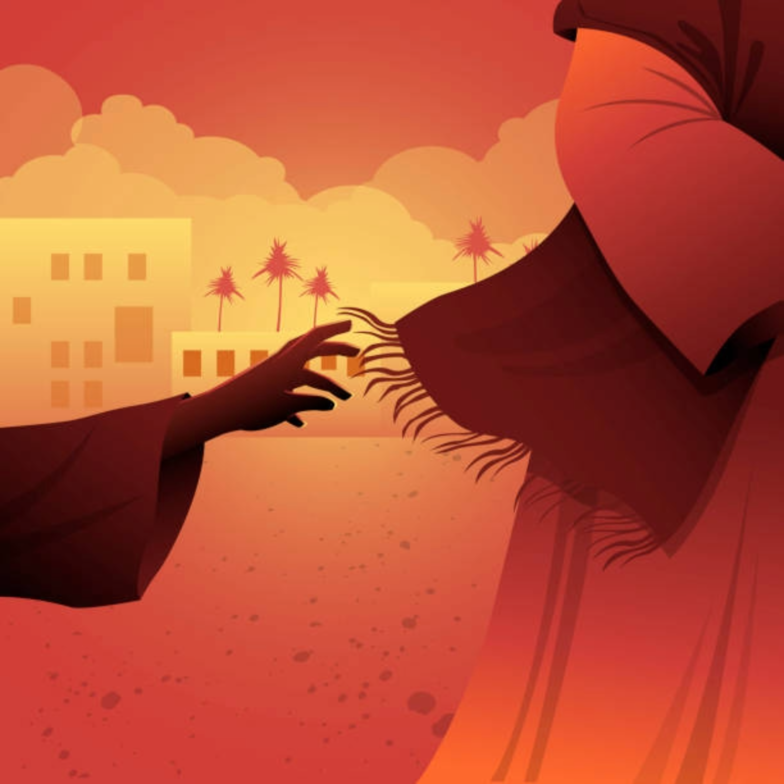
With this in mind, let us turn to today’s Gospel there are several events unfolding, which we see as three different incidents. First, Jesus calls Matthew to follow him. There is another scene where Jesus encountered a woman who has suffered from hemorrhages for twelve years. Finally, Jesus raises a girl from death. Although these seem different incidents, they together summarize much of what Jesus did during his public ministry. Forgiving sinners, healing the sick, and bringing new life. If we look for a common thread, I will say it was all about restoration, in other words, making broken things whole again. Sin breaks relationships. Illness breaks the wholeness of what God has created. Death breaks the very fabric of life, and according to the scripture, it was understood as a result of humans’ broken covenant with God in the garden of Eden. So, Jesus came to the world, to proclaim the good news. And the good news is that God is willing to and eager to restore what is broken and renew what is lost. But how does it happen?
As I shared at the beginning, it happens only within the fabric of our relationship with God. God invites us to take initiative, to take risks, even when it seems impossible for us to do. In doing so, we grow stronger, we gain wisdom, and most importantly, we build trust in God who is always with us. In this light, the people in today’s story were not just merely passive recipients. As Jesus called, Matthew could have refused. We often think about the risks Jesus took in associating with tax collectors and those marginalized by society. It was a scandal and a threat to the existing culture and religious system. Yet, we do not think much of the risk that Matthew had to take. Matthew could have remained in his comfortable life. He likely got used to how people treat him, but other than that, he had power over others since he was allowed to set tax amount including his profit and earned a good income. Also, he must have seen how Jesus words and actions unsettled both the Roman authorities and Jewish religious leaders. By following Jesus, Matthew risked losing his comfort, his privilege, and getting involved in the controversial situation around Jesus.
The same is true for the father of the dead girl, or the woman who suffered for twelve years. By stepping forward and speaking up, they risked drawing attention to themselves and facing criticism, without knowing whether Jesus would be able to help them or not. Many others in similar situations might have stayed where they were, giving up helplessly or complaining hopelessly. Yet, these individuals took the risk with courage and became involved.
Sometimes I wonder What the ingredients of God’s miracle are. The world we live in is in desperate need of God’s miracle, a radical change. The brokenness in our society and in creation is beyond our capacity to fix. It often feels like we cannot provide solutions on our own. And yet, as St. Augustine says, God would not save us without our participation.
In that sense, change, miracle, restoration, renewal, whatever we seek, can only happen as we work with God. It begins with our initiatives but grows through the grace of God. It is a fine art as we find the balance between what only we can do and what only God can do, discern when to persevere and when to entrust things into God’s hands. And we can learn that, only when we continue to converse with God, and walk with God.
As we do, we will come to realize that the gift of God is more than what we get but goes far beyond that. God desires that we become like Him who is the source of good, beauty, and truth, who unites others through loving, trusting relationships. And that is what we are called to be. “Without us, God won’t. Without God we can’t. But together with God, we can.” God is patiently waiting for us to take the first step and gently attending to us as we walk the path. So let us pray to God so that we will always dream beyond our imagination, and take even the smallest first step, and remain open to God who guides us, encourages us, and protects us.
Fr. James
-
Location
Office Hours
Contact

