Feast of St Matthew - SERMON

Seventeeth Sunday after Pentecost
Following last Sunday’s Gospel, where we heard one of Jesus’ most challenging commandments—that we must forgive not merely seven times, but seventy-seven times— today we are given another teaching that does not easily fit our common sense or ordinary social practice. How can the person who worked the whole day and the person who was called at the last moment receive the same wage? If there is no greater reward for greater effort, then what would motivate anyone to work hard?
At first glance, this parable reminded me of a story I once heard. One day, a communist visited a Christian religious community. After observing how the members lived, he said, “This is perfect communism.” Pope Francis and other liberation theologians have sometimes been accused of being socialists or communists. Yet ironically, the Catholic Church has never supported communism as a political ideology; actually, throughout history, it has often been one of its strongest opponents. And yet, when I look back on my own religious life, I can understand why someone might have made that observation.
When we entered religious life, we renounced personal ownership and shared our resources. It did not matter how much income each person brought into the community. Some received generous honoraria as renowned speakers; others had fewer specialized skills and served quietly through household responsibilities. Some were entrusted with many tasks, while others could not do much with their personal struggle. However, at the end of the day, everyone received the same.
We ate the same food, lived in same size rooms, and received the same monthly allowance. If there was ever something extra special meal, better accommodation, or additional assistance was given according to need. I am not a specialist in social theory, but this sounds remarkably similar to Karl Marx’s idea: a society ordered not simply according to ability, but according to need.
Does this mean that some form of ideal communism touches the heart of Christian life? Probably not. Christian vocation involves much more than the way we distribute material resources. The deeper question is not simply, “Who receives what?” The deeper question is, “Who are we?”
First, we are people created in the image and likeness of God. Therefore, we are called to help one another embody that image more fully. Throughout the Old Testament, the prophets repeatedly commanded God’s people to rescue the oppressed, defend the orphan, and plead for the widow. God desires every person to become fully alive and fully human, revealing God’s glory through the wholeness of their life.
But again and again, the people failed to listen. Instead of caring for the vulnerable, they pushed them further aside. Instead of easing their suffering, they ignored it. Finally, the Son of the Father came among us—not merely as a messenger from God, but as himself being God’s message in person.
This brings us to the second truth about who we are: we all belong to one Body of Christ. In baptism, we proclaim that we die to our ego and rise to new life in Christ. We are renewed not merely as isolated individuals, but as members of one body. This is also what we celebrate in the Eucharist.
We receive Christ, and we are received into Christ, becoming one body and one spirit. Through this communion, we enter more deeply into the life of the Triune God—the eternal communion of love.We are bound together in a relationship that is more profound than preference or fairness. In Christ, we are destined to be brought back to wholeness in our relationship with God, and we are called to help one another return to wholeness through our relationships with each other.
This Christian identity and vocation are not optional or conditional. They are not something we take up only when it is convenient or reasonable. At times, as we truly understand the depth of this commitment, it can even feel overwhelming. Our physical body, however, gives us a helpful image.
When one part of the body is weakened by malnutrition, infection, or injury, we do not say, “That is your fault. You are on your own.” We do not withdraw resources from that part precisely when it needs them most. The injured part sends signals of pain. We know that if we neglect it, the whole body will eventually suffer. If we simply numb the pain while ignoring its cause, the condition may worsen and cause the whole body ill—or even placed in danger of death.
In the same way, Jesus’ command to give to the poor and forgive sinners is not merely an invitation to perform generous deeds so that we can become more virtuous individuals. It reveals who God created us to be: one human family, made in God’s image, and one body in Christ.
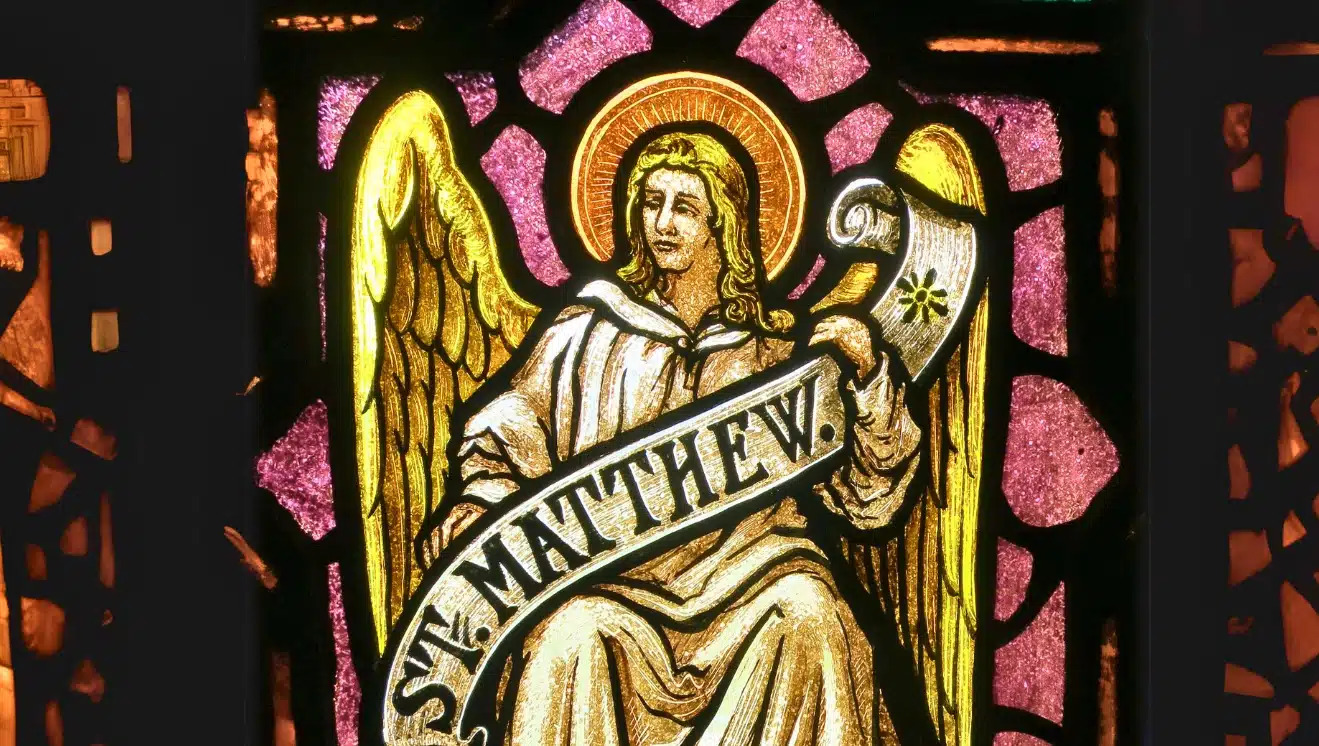
As we celebrate the feast of Saint Matthew, we might wonder what it was like for him to begin this new path. As a tax collector, Matthew may have been materially comfortable, but he was socially despised and spiritually isolated from his own people. Yet Jesus, who was becoming famous like a celebrity through his preaching and miracles, stopped and noticed the person whom almost everyone else had pay no attention. Jesus simply said to Matthew, “Follow me.” Then Jesus shared a meal with him. He spoke with him, listened to him, and treated him as a friend and brother—perhaps in a way Matthew had rarely experienced.
The Gospel does not give us a detailed account of Matthew’s inner response or of every step by which he grew into discipleship. But we can imagine the transformation from a tax collector to an apostle and an evangelist. As he was planted in a relationship where he found love, he must have bloomed and born so much fruit as we know. When others believed Matthew was unworthy of respect, attention, or forgiveness, Jesus received him as if his failures and wrong choices did not have the final word. Those who had worked hard to gain and preserve their social status were understandably baffled and offended. They believed they had earned what they possessed, and they believed that people like Matthew did not deserve to be treated as their equals. But in God’s eyes, every person is a beloved child. That is what matters most to God—and that is what changed Matthew.
As we begin a new program year, we might ask ourselves: What does each person truly need, wherever they may be in life? In today’s parable, everyone receives the same wage. What is the wage—or gift—that God gives us so that we may become fully human?
- We need respect, because every person is imprinted with God-given dignity.
- We need friendship, because no one is meant to be alone.
- We need meaning, because our stories are part of God’s story.
- We need purpose, because everyone is created in God’s vision.
- We need forgiveness, belonging, encouragement, and hope. The list could go on.
Jesus teaches us how to offer these gifts to one another. And as our relationship with God deepens, we will receive the strength and wisdom to care for one another more generously.
May our parish become a true sign of your Kingdom, a community where the last are welcomed, the wounded are restored, the lonely find companionship, and every person discovers that they are beloved. And as we belong to Christ’s one Body, make us instruments of your restoring love.
We ask this through Christ our Lord. Amen.
Father James
-
Location
Office Hours
Contact

