25th Sunday after Pentecost - SERMON Fr. James

One day, I was having a conversation with someone, and he said when he was a youth, the church used to give them stickers to collect when they showed up. Interestingly, I grew up experiencing similar practice in Korea. We called it a “talent sticker.”
The basic idea was simple: when children did something good; such as attending Sunday school, participating in a program, winning a prize, or volunteering to help others, they received a sticker. At the end of the program year, the child who had collected the most talent stickers would receive a gift. As we can easily guess, the purpose was to recognize their efforts, and motivate them to get involved. Yet, as many of you may raise questions, I am not a great fan of this reward system.
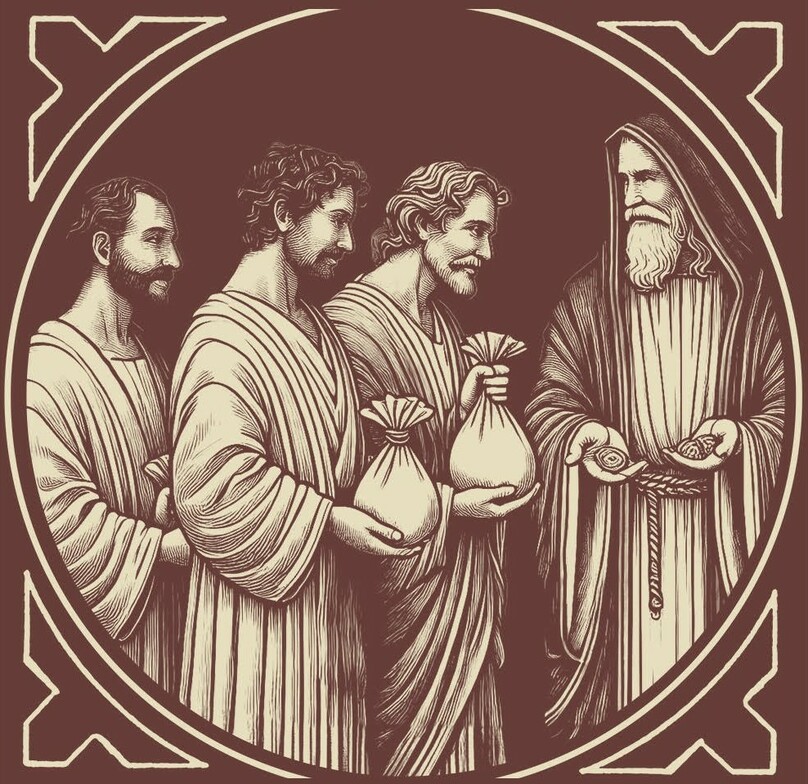
At first glance, it almost seems to resemble what we have just heard in today’s Gospel from Matthew. In the parable, a master entrusts his property to his servants before going on a long journey. Here, a term talent is used, and a talent meant 75pounds of silver or gold, which we can tell one talent was a lot of value.
One servant receives five talents and doubles them to ten. Another receives two talents and makes them four. But the one who receives a single talent does nothing with it; he simply buries it in the ground. When the master returns, he rewards the servants who have made good use of what they were given, but he rebukes the one who did nothing.
So, in a way, if we apply the story to our life in the Church, it may seem to make sense to reward those who use well what they have received. But soon, such a system can make our faith all about earning more stickers. Even worse, it can turn the Christian life into a competition, placing people in a line of first and last.
It may sound absurd, but sometimes we think of our Christian life as a matter of collecting more stickers, more reward points, more spiritual achievements. When someone volunteers for difficult work, I sometimes do not know how to express my gratitude for their time and generosity. So I joke that they are collecting more reward points in heaven.
But if earning points cannot fully capture the meaning of the Christian life, then what does? What would it mean to be a good and trustworthy servant with what we have received from God?
As I pondered this question, I began to think more deeply about what it means to “receive talents and make more talents”. If we are speaking about money, it is fairly simple. We invest it, start a business, or find ways to make it grow. There is a measurable increase. But what does talent refer to in our lives?
We often relate talents to the gifts we have received from God such as our strengths and abilities. If I ask you, “What are your talents?”—just as I did with the children earlier, many of us would give answers similar to those written on the cards: “I can sing.” “I am handy.” “I have a kind heart.”
Then multiplying talents may look like volunteering in the choir, helping someone repair something that is broken, or offering comfort to a person going through a difficult time. Yes, all of this makes sense. But I felt there was something more.
Of course, God has given each of us gifts to use for good purposes. But from my experience, God’s gifts are often more than the things we consider desirable, impressive, or useful. What if all these things we call gifts are simply tools for multiplying the real gift? What if the real gift is not something we can claim as our own, but something to which we belong?
As I reflected on today’s Gospel, I came to think that perhaps the gifts we receive are none other than relationships. Relationships are given to all of us. We are all born into the fabric of relationships. In a very real sense, no one exists alone. Everyone is nurtured through relationships, and at the same time, everyone struggles within relationships.
From a theological perspective, this makes profound sense as well. God is a God of relationship. God exists as three Persons in one unity—Father, Son, and Holy Spirit. And all of God’s actions, including creation and salvation, can be understood as expressions of love. Because we are created in the image of God, we are essentially relational beings.
So let us look at today’s Gospel through the lens of relationships. Some people are given more relationships; others are given fewer. There is nothing good or bad about the number. Some people are naturally more social, while others are more private or reserved.
Yet, regardless of the number, we are all called to help our relationships grow in depth and in width. We are called to make our relationships more genuine, more life-giving, and more open to others. This does not apply only to our relationships with one another. It also includes our relationship with God and our relationship with ourselves.
Then how do our relationships grow? When we begin to see God’s gifts not merely as the things we are good at, but as the relationships that we are part of, a whole new way of understanding our lives opens before us.
It is not simply about being good at something. It is not simply about accomplishing something. Of course, our contributions and efforts for the common good are sweet fruits that we bear. But relationships deepen in many different ways.
Some may say, “I have nothing to offer.” But sometimes, it is enough simply to be present. We make time for God. We make time for another person. We listen attentively. We accompany someone by walking with them.
Others may say, I can’t offer anything, rather, I need help” Yet even in difficult situations—when we are only waiting for help, or when life feels uncertain—we can still help a relationship grow. As we trust God in uncertain times, we grow in relationship with God. As we express gratitude to someone who offers a helping hand, we grow in relationship with one another.
More than anything else, the most important thing would be cherishing our relationships as gifts from God. Once we begin to see and accept relationships we belong to as gifts, then we will be guided to find a way to make relationships grow.
What relationships has God entrusted to you? What relationships has God given you to nurture and grow? Are there relationships that have been buried or set aside, because you do not like them, because they feel too difficult, or because you think they mean so little? What opportunities is God inviting you to reach out again to those long-forgotten or neglected relationships?
Today, as we begin our annual fundraising with the Christmas Fair, we also remember all those young people who have had to begin their lives carrying burdens heavier than many others. We reach out to them with what we have, so that our relationship with them may bring the hope and encouragement they deserve.
May the gifts of relationship that God has entrusted to us flourish as we cherish them, nurture them, and share them generously with others. May we not bury what God has given us out of fear, indifference, or discouragement. And may we one day hear the words of the master:
“Well done, good and faithful servant. Enter into the joy of your master.” Amen.
-
Location
Office Hours
Contact

